

Of Lava and Life
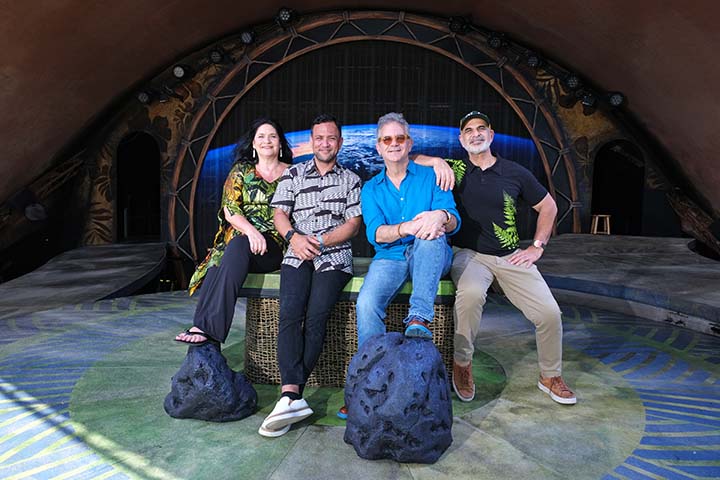
Photo by Lawrence Tabudlo
Tales of ancient Hawaiʻi live through their storytellers.
They are passed down by voice, oli (chant), hula and even the archived Hawaiian language newspapers of the last century. But how do they persist in an ever-evolving world?
In December, Hawaiian mythology takes on a new form. The Epic Tale of Hiʻiaka: The Hawaiian Goddess combines live music, hula, oli, puppetry, projection and storytelling, bringing together ancient traditions with contemporary musical theater.
This is the tale of how the musical production came to be.
Michael Jackowitz was a long way from his home in New York City when he pitched the idea of a Broadway-level musical about Hawaiian gods to world-class musician Kealiʻi Reichel. Ever since falling in love with Hawaiʻi, the Broadway producer had spent a decade waking up to Reichel’s music every morning. While escaping East Coast winters to the islands, he began to wonder why no one had ever attempted a musical based on Hawaiian mythology.
“I knew that unless I knew somebody on the ground in Hawaiʻi who knew both the world of musical theater and Hawaiian culture, that was never going to happen,” says Jackowitz, who was busy running his company, WitzEnd Productions, at the time.
His answer came in the form of Roslyn “Roz” Catracchia, a seasoned composer based here in the islands. Catracchia first met Jackowitz at a preview dinner in 2011 for the American premiere of the Danish musical My Fairytale in Solvang, California. The show featured music and lyrics by her hero, Stephen Schwartz, whom she calls the “Godfather of Broadway” for his composing credits in Wicked, The Prince of Egypt, Godspell, The Hunchback of Notre Dame and more. They connected over Jackowitz’s idea at breakfast the next day.
Two years later, the pair found themselves in the living room of Reichel’s Maui home, fatefully seated beneath a painting of Hiʻiaka. Jackowitz’s pitch was simple: The world is fascinated by Hawaiian culture, yet knows very little about it, and this would be a brand-new medium to tell these stories.
Reichel headed into the back of his house and returned with the nearly 500-page book, The Epic Tale of Hiʻiakaikapoliopele. It detailed the bond between Pele, goddess of the volcano, and her younger sister, Hiʻiaka, who sets off on a quest to bring back Pele’s lover, Lohiʻau.
Jackowitz recalls Reichel saying to him, “This is our Lord of the Rings. This is our epic story. This is the story you should tell.”
Bringing the production to the stage was anything but easy.
“It’s not for the faint of heart to make musicals,” says Jackowitz, who moved to Hawaiʻi to see the production through. “You really have to be in it for the long haul.”
It took more than a decade to get the story right. Catracchia says that she, Reichel and her co-writer and the musical’s choreographer, Patrick Makuakāne, would hold “rambling sessions,” talking through a subject until a strong lyric or song emerged. She says it was key to “ask a lot of questions of the people who know more than you.”
“When people are talking, oftentimes it’s like a sifting process,” Catracchia explains, “and things come to the surface that are like gems and jewels … That’s how all the songs came about.”
It Clouds the Heart took 27 versions and many years to write. Another difficult song was Kuleana, which Catracchia describes as Hiʻiaka’s “I want” song. After going through multiple versions, she landed on one that earned compliments from Schwartz, who became a development adviser for the musical.
“If all the songs are up to this level of quality, you’re on to something very special here,” he wrote in an email to her, according to Catracchia.
Catracchia says she remained dedicated to the musical over the years because of the cast.
“I could tell by the people who we chose to be in the cast for the reading — when they were moved by it, something special was happening,” she says.
With support from Hawaiian Council CEO Kūhiō Lewis, Hiʻiaka gained a venue at Ocean’s Edge in Ko Olina and the production resources to back it.
“This work is part of Hawaiian Council’s broader vision to redefine Hawaiʻi as a destination rooted in culture, authenticity, and a genuine connection to our people and place,” Lewis says. “We must take a greater role in reclaiming and shaping our destination, ensuring that as Hawaiʻi evolves, the identity of our people, our places and our culture remains intact.”
Last year, a 45-minute preview of Hiʻiaka was shown at Hawaiian Council’s Native Hawaiian Convention in Tulalip, Washington.
Jackowitz recalls being told that “the whole first row is gonna be all the aunties and if they don’t like it, we’re done. They could shut us down.”
However, when the presentation ended, those same aunties were standing and crying. When the cast reentered the convention center, applause erupted from the attendees. That’s when Jackowitz himself cried over the reception.
“We set out to tell the story as truthfully and compellingly as we could,” Makuakāne says. “What audiences bring to it will inevitably differ, and that’s perfectly fine. The invitation is open to everyone, but the story doesn’t have to change depending on who’s in the room.”
Makuakāne describes the emotional landscape of the story — love, jealousy, betrayal, loyalty and the complicated bonds of family — as universal experiences.
“Those emotions provide an entry point for everyone,” Makuakāne says. “But the world in which they unfold is distinctly Hawaiian, and we wanted to honor that without compromise.”
Hiʻiaka can stand on its own without prior cultural or language knowledge, proving to be a production for all audiences, especially kamaʻāina.
“We’re going to use this medium to tell the Hawaiian story to not only a new generation of people here, but potentially all over the world,” says Jackowitz.
At the end of the day, the sister goddesses are not confined to a book or even a musical production.
“I want people to know that Pele and Hi‘iaka are alive and well,” Jackowitz says.
He, Catracchia and Makuakāne traveled to the real-life sites mentioned in Hiʻiaka’s story to gather inspiration and learn the moʻolelo (stories) from Reichel.
Along the Nāpali Coast on Kauaʻi, the team saw the boulder bodies of the vanquished moʻo (lizard-like water spirits) that Hiʻiaka battled to reach Lohiʻau. At Hāʻena Beach in Keaʻau on Hawaiʻi island, where Hiʻiaka meets her friend Hōpoe, Catracchia describes the surreal feeling of sinking her feet into the black-and-white swirls of sand while listening to Reichel recount stories of the sacred land on which they stood.
At Kīlauea, Pele’s volcanic eruptions create new land, and several months later, Hiʻiaka’s flowers begin to bloom in those same areas.
“These two sisters have been intertwined from the beginning, and this is their origin story,” Jackowitz says. “This musical tells the story of how Pele and Hiʻiaka became intertwined, and why it’s essential that they do.”
In their author’s notes, Catracchia and Makuakāne conclude: “And perhaps that is what makes this ancient story so enduring. The volcano will erupt again. The forest will return. Destruction and restoration will continue their eternal dance.
“And the sisters, bound to one another by forces greater than their own desires, must somehow find a way to live with what they have done, what they have lost and what they still love. As must we.”