

No Stress, Pus’ Press
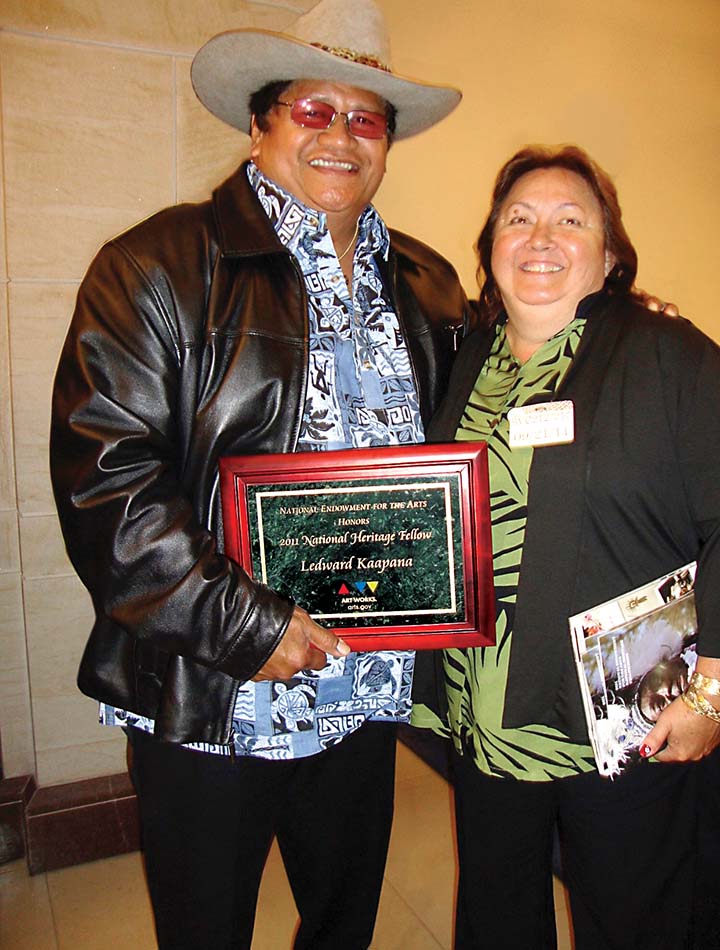
Photo courtesy Sharon Kaapana
Ledward Kaapana doesn’t need a stage to play music. He makes his own wherever he goes. From airports and backyard parties to bowling alleys and lakeside lanai, the music legend, along with his trusty guitar and ʻukulele, draws in people who are captured by his sound, many of whom can’t resist dancing.
“I learned this when I was small,” says Kaapana as he leans forward with a wide grin. “When you see anybody stand up and dance, you doing good. They go (and dance), I tell you, because the music, the music grab them, grab them as they feel it. And the way they dancing, that’s how they feel.”
With more than 40 years of entertaining crowds around the world both on and off stage, Kaapana is best known for his slack-key guitar skills but is equally masterful on the ʻukulele and as a vocalist. Over his career, he has earned numerous awards both as a solo artist and as a member of his previous bands. He started in Hui Ohana, a group formed in his teens with his cousin, Dennis Pavao, and his younger twin brother, Nedward (born just five minutes apart). Together, they won the Lifetime Achievement Award in 2005 and released 14 albums throughout the ’70s — works that are considered key to the resurgence of traditional Hawaiian music during the Hawaiian Renaissance.
After Hui Ohana’s disbandment, Kaapana formed Ikona. The group released six albums, including the Nā Hōkū Hanohano Award-winning album, Jus’ Press, which is named after Kaapana’s signature catchphrase that he got from his uncle, expert slack-key guitarist Fred Punahoa.
This month, Kaapana adds yet another hulu (feather) to his feather-studded hat as a recipient of Hawaiʻi Academy of Recording Arts’ 2026 Lifetime Achievement award — this time celebrating his legacy as a solo artist. He is joined in this honor by fellow musical greats Henry Kapono Ka‘aihue, Keali‘i Reichel, Na Leo Pilimehana, and Leon & Malia. The honorees will be celebrated for their meaningful contributions to Hawaiian music at The Royal Hawaiian Resort on Nov. 15. (A limited number tickets are available through HARA Hawaiʻi.)
“It feels a little different because it’s all me,” says Kaapana about winning the award as a solo artist. “I’ve been out there and doing my hard work, doing what I love to do, especially playing music. I love playing music. I play any place. If I’m not doing nothing, I have my guitar, I always playing.”
Playing anytime and anywhere is a habit Kaapana picked up from his family. He was born in 1948 in Pāhala in the Kaʻū district on the Big Island. His parents, aunties, uncles and their friends always kept the house full of music, playing all throughout the night and taking shifts while the others slept to keep the music going. Kaapana remembers joining in when he was just 6 years old, messing around on the ʻukulele alongside his twin brother.
The family moved to Kalapana in the Puna district in 1956. The house had no electricity and the kids learned how to live off the land. Kaapana spent his days in the nearby ocean — surfing, swimming, picking ʻōpihi and fishing. Nights, though, were reserved for music.
“We all sit down and listen, and we just watch and observe, and that’s the way I learned,” Kaapana explains. “(My family) play from within because nobody reads (music) notes, and so I still do that today. I play from within. People ask me, ‘Can you play with anybody?’ I say ‘Yes, I’m not afraid to play with anybody.’ I feel the music. That’s the way I was brought up.”
From these days of watching, listening and playing alongside family, Kaapana learned how to play songs by ear and, more importantly, from the heart. Kaapana’s fan base — referred to as “Led Heads” — praises Kaapana’s ability to play with pure passion. Kaapana says it’s not something he thinks about; it’s natural for him to let the music flow as it needs to for that specific performance.
“One thing about playing from the heart, this way, is you play with a lot of feelings,” shares the 2024 Hawaiian Music Hall of Fame inductee. “It’s not (about) following a note, so every time the song comes out and I play the song, it’s a different feeling. Next time and each time, the song sounds even mo’ betta and betta.
“I’m not trying to change the music, but it just comes and I can feel it and (it) goes through the body, to the finger, to the guitar, and even me, I get surprised like, ‘Whoa!’ Yeah, I get surprised like ‘Wow, that was nice,’ and it keeps on going. It’s always fresh.”
While Kaapana always played music, he didn’t initially intend to be a career entertainer. Originally, he worked in construction. One of Kaapana’s uncles invited the Kaapana twins and Pavao to work on the first telescope on Mauna Kea. The men agreed, although Kaapana worked alone with his uncle the first few days. The other two stayed back after becoming sick due to the mountain’s high altitude.
The same uncle later invited the trio to work in construction in Honolulu. The men agreed and moved to Kalihi, working at the OUTRIGGER Hotel in Waikīkī. They worked hard and partied harder. On weekends, they would come home to Kalihi to drink and play music all night. Encouraged by a family member, Kaapana with his brother and cousin started to informally perform at the lounge of Leeward Bowl in Pearl City.
“Every time … the three of us, no name, nothing,” Kaapana recalls with a laugh. “We just played, and then the next day we get up 4 o’clock in the morning just to go Waikīkī because the truck come early in the morning. We all tired.”
Eventually, it came to a breaking point. Kaapana’s uncle sat the three men down and asked them: “You guys like work or you guys like play music?” Without hesitation, the trio chose music. Now, decades later, Kaapana continues to choose music every day.
Music isn’t always the easy option, though. Kaapana shares that there were points throughout his career when he didn’t think he could continue on, namely after the heartbreak that resulted from the Hui Ohana breakup. Through it all, the person who didn’t give up was Kaapana’s wife and manager, Sharon.
“I was ready to quit,” Kaapana says about the group’s disbandment, “but my wife told me ‘You cannot quit.’ I said, ‘I cannot find anybody, you know.’ After coming up from a group like Hui Ohana, was rough. I started (playing music again), and my own family told me, ‘Ah, no sound good.’”
Encouraged by Sharon’s unwavering faith, Kaapana kept playing despite the challenges. He formed the award-winning group, Ikona, and even after that group parted ways, Sharon pushed Kaapana to hold on and keep going as a solo artist.
“My wife is my CEO,” says a serious Kaapana before breaking into laughter. “That’s what I always say. She’s the one setting up all the jobs. Before you had managers, you go on stage and then you fighting like, ‘What happened to the money?’ So I get her involved. When she was young, she got involved and now she knows the ropes. Now I no have to worry. I go on the stage and do my job. She take care of whatever. It’s easy now. Mo’ comfortable playing music. Before it was hard to perform on stage.”
The couple celebrated their 50th anniversary of being together back in July, having met as teenagers and sticking to each other since then.
“Every place we go, we always going together,” Kaapana says.
To remain updated on where Kaapana is playing, visit ledkaapana.com. Each performance may be different, but one thing stays the same: Wherever he goes, the music and dancing comes with Kaapana — each performance promised to be mo’ betta than the last.