

On Top Of The World
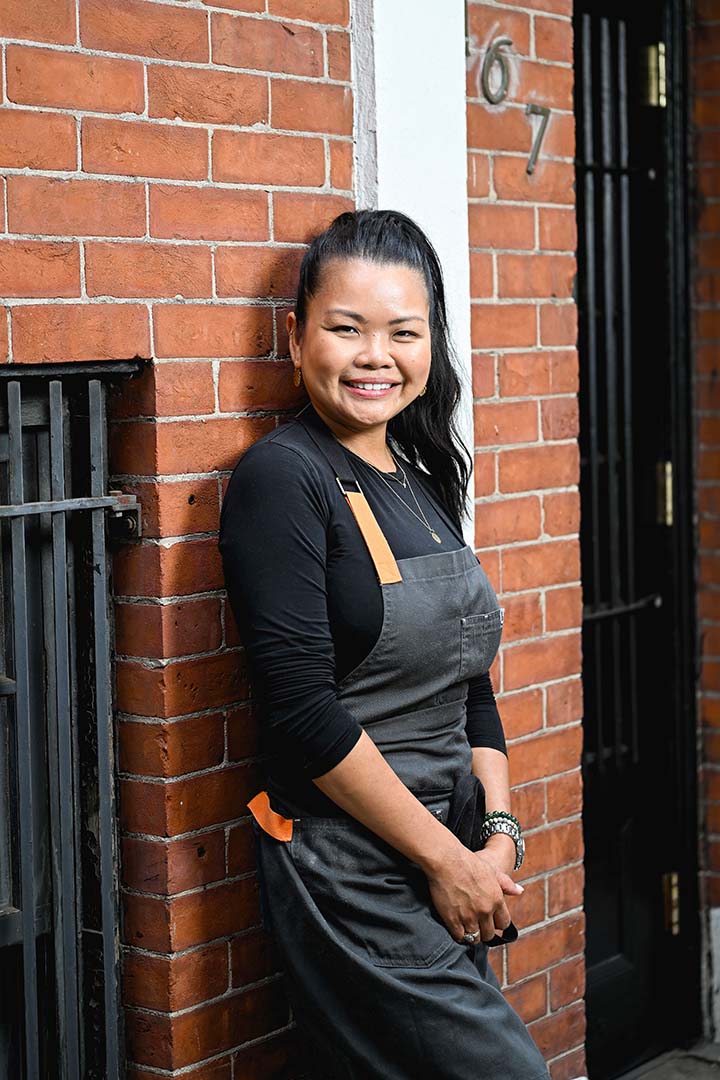
Photo courtesy Max Flatlow
Rhoda Magbitang will be the first to admit Filipino cuisine is not her métier. Despite growing up in the Philippines, she’d honed her skills at Le Cordon Bleu in Pasadena, California, where she absorbed the foundational French culinary techniques that would take her to acclaimed restaurants like The Bazaar by José Andrés, Suzanne Goin’s A.O.C., and the Michelin-starred Mélisse.
But Filipino food is what she’s best known for now because it carried her to victory on Bravo’s Top Chef earlier this year. For the finale episode that aired in June, she served a four-course meal that paid homage to the lutong-bahay, or Filipino comfort food, that flavored her childhood in Antipolo, near Manila.
Her elevated take on those cherished home-style dishes impressed host Kristen Kish and judges Tom Colicchio and Gail Simmons. A guest at the finale meal called her tortang talong, or grilled eggplant omelet, “a revelation” and after she won, the U.S. Embassy in the Philippines issued a public congratulations.
“It was eye-opening for me,” Magbitang says of the experience. “Filipino food is not my repertoire, it’s not something I cook professionally, so when the show came out and all of that happened, what I didn’t expect was the outpouring of support from the Filipino community.
“I did what I did for the finale because that’s what spoke to me and that’s what made sense for the final challenge — dedicating dishes to my upbringing and my parents and my food memories. The way a lot of Filipinos were able to relate to the dishes was really incredible.”
The Top Chef win launched Magbitang into the celebrity chef stratosphere. Fans showed up at Mauna Lani Resort’s CanoeHouse on the Big Island, where she is the executive chef, for a chance to meet her.
Auberge Collection, the hospitality brand management partner for Mauna Lani, capitalized on the victory by launching a series of intimate beachside dinners featuring Magbitang and fellow season 23 contestants Sieger Bayer, Oscar Diaz, Brittany Cochran and Duyen Ha. Magbitang also made appearances at Auberge properties on the mainland.
She says connecting with new supporters — especially kids who have epicurean dreams of their own — really brought home the weight of her accomplishment.
“It’s such a cool experience, but it’s also really humbling,” she says. “It’s kind of like that Spider-Man quote, ‘With great power comes great responsibility.’”
It’s not just up-and-coming talent seeking her out. The culinary stars she’d watched from afar have welcomed her into the fold. In June, she walked the red carpet at the James Beard Awards in New York City, then shared the stage with host Andrew Zimmern.
“It’s surreal because you’ve watched these people on TV and you think, ‘Oh, one day maybe it’ll be me,’” she says.
She returned to the James Beard Foundation in August to prepare a multi-course “Island to Island” meal that traced her personal and gastronomical journey from the Philippines to Hawai‘i: abalone lugaw, sticky pork belly adobo, and oxtail served with crispy tripe and peanuts.
While Top Chef may have put Magbitang in the spotlight, long before she’d stepped in front of the cameras she’d been quietly working her way up the culinary ladder.
In 2024, she became the first woman to ever lead the culinary team at the CanoeHouse. The role put her at the head of a talented kitchen crew that serves up to 300 guests a night.
“I have a chef de cuisine, a sous chef, three chef de parties and our line cooks, they’re our soldiers. I would not be where I’m at now if it wasn’t for them,” she says.
Before coming to the CanoeHouse, she designed the seasonal, West Coast-forward menu at the revamped Inn at Mattei’s Tavern in Los Olivos, California. Auberge Resorts Collection spent several years transforming the historic property into a luxury resort. Within months of its opening in February 2023, the Michelin Guide had included it in its prestigious listing of notable places to eat.
Magbitang has always enjoyed being in the kitchen. The oldest of six children, she helped cook family meals. But it wasn’t until she moved to the United States at age 17 to join relatives in the Golden State that she considered pursuing it professionally.
“Growing up in the Philippines, becoming a chef never really felt like an option,” she says. “Food was always a huge part of my life, though. I grew up surrounded by a big extended family, and we shared almost every meal together. I also spent a lot of time helping my grandmother, who operated a food stall, so some of my earliest memories are of preparing ingredients and cooking alongside her.”
In California, she weighed careers in nursing and teaching before landing at Le Cordon Bleu.
“I don’t think there was one particular moment when I realized I was good at (cooking),” she says. “It was more about continuing to learn, gaining confidence through experience and realizing that I genuinely loved what I was doing.”
Turning out elaborate dishes on a tight deadline and navigating surprise challenges appears stressful to the average Top Chef viewer. Magbitang says she could handle those things; waiting for the judges’ verdict was the excruciating part.
“When the timer is done — and the timer is real — you drop everything and you present your dish and you exit the studio and the judges deliberate. You can’t talk during this period. So you’re sitting with your own thoughts about how much you sucked and why did you agree to this and you could be sitting on a beach in Hawai‘i having the best time instead.”
So why did she take a chance on Top Chef? She says she’d turned down earlier requests to try out. On the surface, it makes sense. Magbitang is not a big talker.
“The less I talk, the more I’m able to focus on what I’m doing, but that’s not very conducive to TV,” she notes with a laugh.
She can be friendly and engaging but doesn’t seem to crave attention. She describes her style as “quiet confidence.”
“Sometimes the producers are in your face and I’m like, ‘Don’t talk to me now,’” she says. “But sometimes I would tell them, ‘Hey, I need maybe 10 minutes of quiet. Approach me after 10 minutes and I will talk your ear off.’ And they would do it. Not a lot of people know you can do that.”
Even on TV, she found her flow state in practicing her craft, not talking about it.
“The best way to gauge someone’s skill is when no one’s looking and they’re still performing at a high level,” she says. “You can’t (fake) your way out of a good stew. A stew is a stew is a stew. If it’s good, it’s good. If it’s not good, that’s a technical error.”
To her way of thinking, cooking comes down to formulas and muscle memory from years of work.
“The little components add up, and with your time you have to be really smart,” she says. “Being in a restaurant setting day in and day out gets you really good at time management. It’s a practice, not really a skill. It’s something you have to hone and practice every day.”
But ultimately, she can’t explain what compelled her to audition this time. Maybe the stars had finally aligned: She had the skills, the experience and the desire to see how far she could push herself. Perhaps, like her show-stopping kaldereta (slow-braised short-rib stew), all of the ingredients had marinated into something greater than the sum of their parts.
“It kind of felt almost like an unseen force made me do it,” she says. “And I’ll stand by this: I don’t think I would have done as well as I did if I did this at any other time.”
Follow Magbitang on Instagram
(@rockyrhodakill). Season 23 of Top Chef is available for streaming on peacock.com.